

There has already been a lot written about Christopher Nolan’s The Odyssey, with many articles online complaining about the cast or how Nolan has interpreted Homer’s famous epic. Ironically, the majority of these articles were written before the film was even released, with most of the information being based on supposition rather than giving Nolan the benefit of the doubt. I’d understand people’s doubts if Nolan hadn’t directed some of Hollywood’s most successful blockbusters, but when he has the likes of The Dark Knight (2008), Inception (2010) and Oppenheimer (2023), I would maybe just wait until I saw the film.
When I first heard that Nolan was taking on The Odyssey, for some reason I had assumed that his would be a grounded take on the material, similar to Uberto Pasolini’s The Return (2024) which featured Ralph Fiennes as a shell-shocked Odysseus. So, I was quite surprised upon the release of the first trailer to see that Nolan had gone down the fantasy route, which made me all the more interested in the feature. It has been a long time since we’ve had a fantasy epic like this, with The Odyssey harkening back to Hollywood classics such as Jason and the Argonauts (1963), albeit, less family friendly in its storytelling.
The level of ambition and scale on show puts most modern blockbusters in the shade, with Nolan’s film also having a level of intelligence that is sadly missing in a great deal of modern action movies. With as strong a focus on character as it does on spectacle, Nolan has once again excelled himself. Viewers should throw away any initial concerns around Nolan’s casting choices and allow themselves to be swept away with his depiction of Homer’s tale.
Of course there will be naysayers, most of whom probably haven’t even seen the movie. Whilst Oppenheimer (2023) received numerous plaudits, The Odyssey easily surpasses it in terms of entertainment. This is obviously just my personal opinion, but I found Oppenheimer to be extremely overrated and wouldn’t even put it in the top five of Nolan’s best. Whereas, The Odyssey is Nolan at the top of his game, and while it is early days, it may already be my favorite of his work.


Interestingly, but not exactly surprising, Nolan takes a non linear approach to the material, opening the film with Travis Scott’s Bard telling tales of the long absent Odysseus (Matt Damon), who has now been away from Ithaca for 20 years. Most think he is long dead with only his loyal wife Penelope (Anne Hathaway), his son Telemachus (Tom Holland) and half-blind Eumaeus (John Leguizamo) believe he will one day return.
Telemachus spends much of his time tending off multiple suitors sniffing about his mother, with them all looking to become the new ruler of Ithaca. The slimiest of these would be step dads is Antinous (Robert Pattinson), who tries to use the law of the gods against Telemachus in the hopes of clearing the way for him to seize the throne.
Looking to find the truth about his father, Telemachus decides to travel along with the loyal Mentor (Ryan Hurst) to speak with King Menelaus (Jon Bernthal), in the hope he has information of his father’s whereabouts.
At the same time, Odysseus is currently living under the enchantment of Calypso, using her magic (or drugs) to make him forget his past. Meanwhile, with Calypso’s help, Odysseus’ fractured memories slowly start to come back to him, where he starts to recall his and his men’s perilous journey back home.
As mentioned, the above synopsis isn’t told in chronological order, with Nolan having great fun in splintering the story apart and putting it back together like a puzzle. The rearrangement of the narrative perfectly conveys Odysseus’ own shattered memories as well as showing the slippage of time.
Apparently Nolan made his cast and crew watch three films for inspiration. These were Andrei Tarkovsky’s Andrei Rublev (1966), Akira Kurosawa’s Ran (1985) and Martin Scorsese’s The Last Temptation of Christ (1988). Upon watching The Odyssey, you can definitely see the influence each of these films had on Nolan’s take on the material, especially in how each of them focus on morally complex individuals, albeit in an epic story.

The strong focus on character is easy to compare with Tarkovsky’s Andrei Rublev, with him never letting the epicness of his tale get in the way of the performances. The sheer scale of Kurosawa’s Ran is also more than mirrored here by Nolan, with The Odyssey’s action scenes being some of the best he has ever helmed. With Nolan having a tendency to shoot on IMAX, it could be argued that the scale of his action scenes is slightly lost on a smaller screen. However, the level of impact lost is minuscule, with Nolan and his team ramping up the excitement when required.
I had noted some people online that you wouldn’t get the same enjoyment out of the film unless seeing it in IMAX, which is frankly bullshit. Sure IMAX is great, but if a film only works in one particular type of theater, I would say that Nolan had failed. I didn’t view the film in IMAX and was still able to revel in the sheer scale of the production and its action scenes.
The best of the action is left for the finale, where Odysseus takes on single-handedly all those who look to take his throne. Using an assortment of weapons, including Odysseus’ famous bow, the ensuing set piece is equally frenetic as it is cathartic as you see certain characters finally get their comeuppance.
This isn’t to say there aren’t some spectacular set pieces before this. Odysseus and his men’s encounter with the Cyclops is fantastically done, and while it has been altered from the original text, Nolan still makes it worthwhile. If anything, this particular set piece encroaches into horror territory in the way it is handled, with the Cyclops appearing from the dark and picking off its victims one by one.
Accompanying the action is yet another wonderful score from composer Ludwig Göransson, making this his third collaboration with Nolan after Tenet (2020) and Oppenheimer. I have noted some complaints online about the score, but personally I felt that it worked wonderfully in the film, with Göransson assisting in setting the mood and tone of the film, with him apparently using an assortment of ancient Greek musical instruments.
Occasionally, the cinematography of Hoyte van Hoytema does border on the dark side, but to be honest, this could have been down to the cinema that I viewed the film in, rather than the work of the ace cinematographer. There is a slight use of shaky cam, but nothing like what was employed in Nolan’s earlier Batman Begins (2005) where a lot of the action became undecipherable. Hoytema’s work put me in mind of cinematographer Morten Søborg’s on Nicolas Winding Refn’s Valhalla Rising (2009), although The Odyssey is a much larger scale production.
What The Odyssey has in its favor, and something Batman Begins (and other Nolan films) did not, is that it is unapologetically R-rated, so there isn’t any need for Nolan to use camera tricks such as shaky cam to obscure the violence on screen. Nolan lets the blood flow freely, with this easily being his most violent film to date.

Unsurprisingly, Matt Damon is fantastic as Odysseus, a morally conflicted “hero” filled with shame and regret. Partly it is Odysseus hubris that sets him and his men on their death-filled path, with Damon once again proving to be one of Hollywood’s best at portraying the different facets of such a complicated character. Damon has also got himself into ridiculous shape for the role, which will also come in handy for the long gestating 6th entry in the Bourne franchise, which Damon confirmed this week is still happening.
The supporting cast reads like a who’s who of Hollywood talent, with several Nolan regulars appearing. However, many of these famous names only feature in small, albeit, important roles. Considering the supposed “outrage” at the casting of Elliot Page and Lupita Nyong’o, each of them have mere minutes of screentime. The same is true of many of the cast, with the likes of Zendaya, Benny Safdie and Charlize Theron only appearing in a handful of scenes. With Safdie, you don’t even get to see his face other than a brief glimpse.
Of the other cast members to get a fair amount of screen time, Tom Holland more than holds his own as Odysseus’ frustrated son Telemachus, with this being the polar opposite of the type of hero he plays in the Spider-Man films.
Holland’s best scenes are shared with Jon Bernthal. These could easily just be used for simple exposition, but Holland and Bernthal’s performances come across very natural, with them being extremely comfortable in each other’s presence.
Anne Hathaway brings a steely determination as Odysseus’ wife Penelope. She could be seen as somewhat cold, but she is clearly terrified of losing her son as she has her husband. Hathaway’s part isn’t as large as her other Nolan roles, but her character is integral to the film.
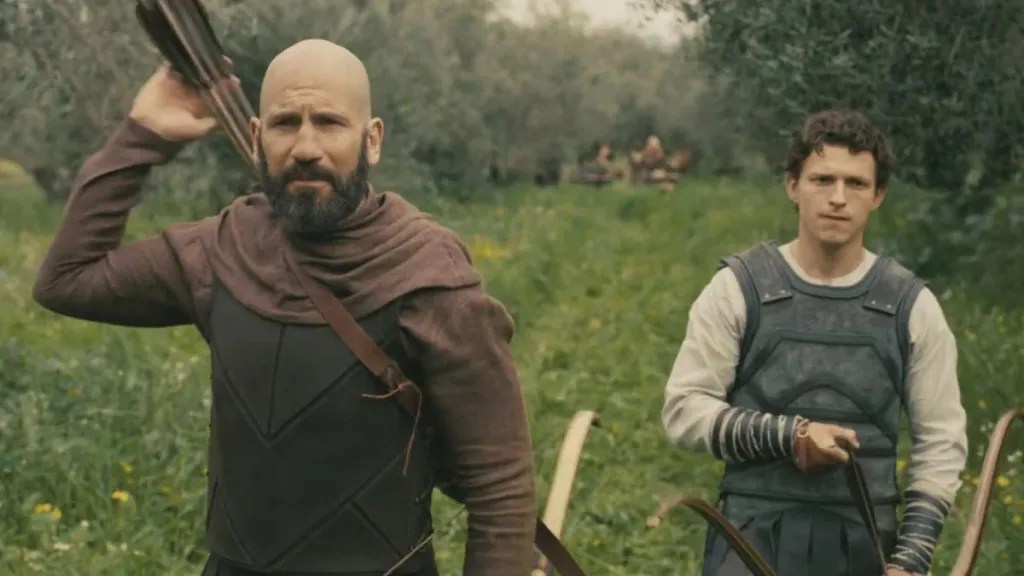

Also integral is John Leguizamo, who gives the film a lot of heart as Odysseus’ loyal friend Eumaeus. Leguizamo can be hit or miss, depending on the role, but he is wonderful here, easily giving one of his best and most memorable performance.
Then there’s Robert Pattinson, playing possibly his slimiest role to date. It’s wonderful to see a performer like Pattinson, someone who made his name playing a romantic hero in Twilight, go all in to play such a horrible bastard.
It would be remiss of me not to mention personal favorite Andrew Howard who features as one of Odysseus’ men. Howard recently starred in William Kaufman’s excellent Man of War (2026), where he almost stole the show. While he doesn’t get the opportunity to do the same here due to the nature of his role, I was just happy to see Howard feature in such a large scale production, with him getting a considerable amount of screen time.
I would urge anyone to go see The Odyssey in cinemas. Don’t listen to the naysayers, most of whom haven’t even seen it. This just isn’t the film for them. This is big budget filmmaking at its best, and easily one of the best, if not the best film of the year.

Plot: 5/5
Acting: 5/5
Action: 5/5
Overall: 5/5


